
Choosing a Breast Reconstruction Surgeon in Denver: A Patient's Checklist

Choosing who performs your breast reconstruction is one of the most consequential decisions in your treatment. Beyond credentials, the right surgeon combines microsurgical experience, a track record of natural results, and a practice that coordinates closely with your broader cancer care. Here's what to check before you commit.
1. Confirm board certification
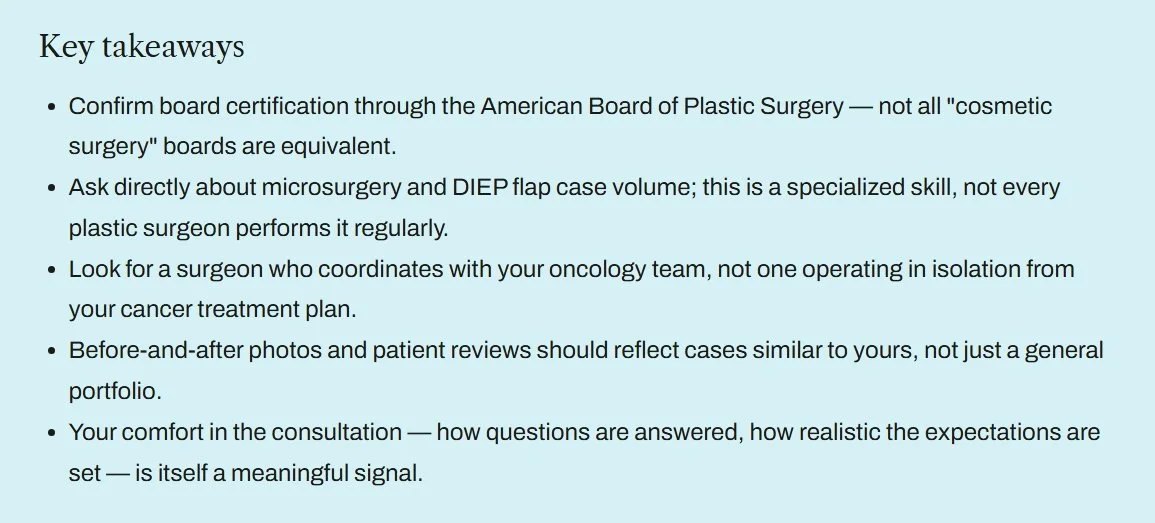
Look specifically for certification by the American Board of Plastic Surgery (ABPS). This certification requires accredited plastic surgery residency training and rigorous written and oral exams — it's distinct from other "board certifications" that sound similar but require far less specialized training. You can verify certification directly through the ABPS website.
2. Ask about microsurgery and DIEP flap experience
Not every plastic surgeon performs microsurgical, autologous reconstruction like DIEP flap — it requires additional fellowship training and ongoing case volume to maintain skill. If you're considering this option, ask directly how many DIEP flap procedures the surgeon performs per year and what their flap success and complication rates look like.
3. Review before-and-after photos and patient reviews
A photo gallery is most useful when it includes patients with a body type and reconstruction goal similar to yours. Look beyond the star rating in reviews to what patients actually describe — communication, honesty about results, and how complications (if any) were handled.
4. Understand their approach to sensation-restoring techniques
Sensation is often overlooked in reconstruction planning, but nerve-sparing and nerve-coaptation techniques during flap surgery can meaningfully improve the chance of regaining feeling over time. Ask whether and how the surgeon incorporates this into their technique.
5. Check hospital affiliations and care coordination
Breast reconstruction rarely happens in isolation — it's usually one part of a broader treatment plan involving your breast surgeon or oncologist, and sometimes a radiation oncologist. A reconstructive surgeon who coordinates closely and communicates with that team helps timing, technique, and outcomes align with your overall cancer treatment.
6. Evaluate the consultation experience
A good consultation should leave you with a clear, realistic understanding of your options — including the ones that aren't recommended for you and why. Notice whether your questions are answered directly, whether risks are discussed candidly, and whether you feel rushed or heard.
7. Consider location and continuity of care
Reconstruction often involves multiple visits over months, from initial surgery through drain removal and any revisions. A surgeon and practice located within reasonable distance of your home makes that ongoing care meaningfully easier to manage.
Questions to ask during your consultation
Are you board-certified by the American Board of Plastic Surgery?
How many breast reconstructions, and specifically DIEP flap procedures, do you perform each year?
What reconstruction options am I a candidate for, given my anatomy and treatment plan?
How do you coordinate with my oncology team?
What does your revision rate look like, and under what circumstances would a revision be needed?
What can I expect for recovery, timeline, and follow-up visits?
Frequently asked questions
Do I need a referral to see a reconstructive plastic surgeon?
Typically no, though many patients are introduced to a reconstructive surgeon through their breast surgeon or oncologist. You can also seek a consultation directly, especially if you want a second opinion on your options.
How soon after diagnosis should I meet with a reconstructive surgeon?
Ideally before your mastectomy is scheduled. Reconstruction options factor into surgical planning, and meeting early gives you time to understand your choices without feeling rushed.
Is it normal to get a second opinion for reconstruction?
Yes, and most surgeons welcome it. Given how personal and long-term this decision is, a second consultation is a reasonable step, not a sign of distrust in your care team.
What should I bring to a reconstruction consultation?
Bring your pathology and treatment records if available, a list of questions, and a clear sense of your priorities — whether that's minimizing recovery time, avoiding an implant, or optimizing for long-term sensation and natural feel.